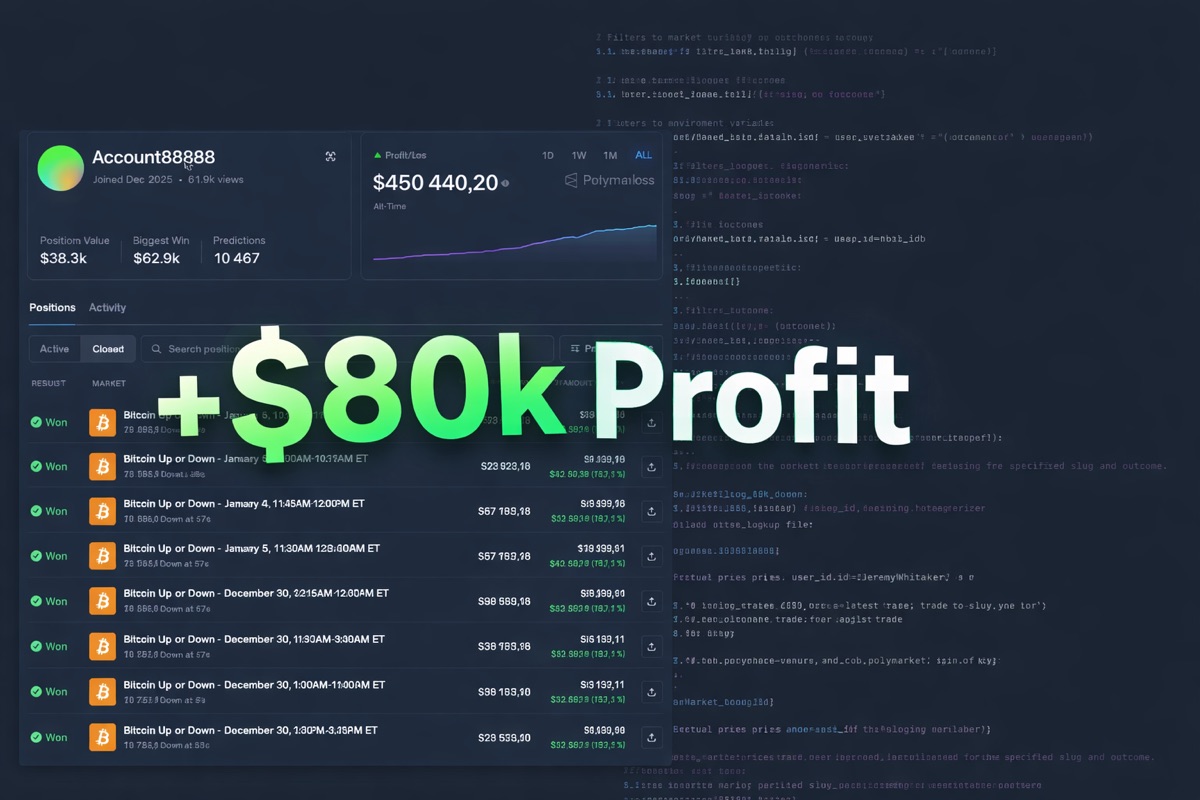
Someone just shared their bot stats: $80,000 in a single week. Not from lucky bets. From systematic automated trading.
A year ago, Polymarket was a niche crypto experiment. Now it’s a legitimate trading venue where sophisticated players are making serious money.
Here’s what’s actually happening and what it means for everyone else.
The New Polymarket Reality
Polymarket did $10 billion in trading volume in November 2025 alone. That’s more than many traditional exchanges. And with that kind of volume comes professional traders.
The bots making $80K/week aren’t using magic. They’re using the same strategies that work in any market: speed, scale, and statistical edges.
What changed is that Polymarket now has enough liquidity to support these strategies. A few years ago, there wasn’t enough money flowing through to make bot trading worthwhile.
What These Bots Actually Do
The $80K/week bot runs multiple strategies simultaneously:
Market Making
The bot constantly offers to buy slightly below fair value and sell slightly above. When both sides get filled, it captures the spread. Do this thousands of times a day and the profits compound.
News Arbitrage
The bot monitors news sources and social media. When something happens that should move prices, it trades before humans can react. Speed is everything here - we’re talking milliseconds.
Cross-Platform Arbitrage
When the same outcome is priced differently on Polymarket vs Kalshi vs other platforms, the bot captures the difference. These gaps exist because markets aren’t perfectly efficient.
Inventory Management
The bot never holds big positions for long. It’s constantly trying to flatten its exposure, taking profits and moving on.
The Capital Requirements
Let’s be real about what it takes:
To make $80K/week, you need significant capital deployed. If you’re making 2% weekly returns, that implies around $4 million in active trading capital.
Most people don’t have $4 million sitting around. But here’s the thing - the same strategies work at smaller scales, just with smaller absolute returns.
$10,000 at 2% weekly = $200/week = $10K/year. Not life-changing, but not nothing either. And you’re learning the game.
Who’s Running These Bots?
The people making real money fall into a few categories:
Crypto-native traders: People who’ve been doing DeFi arbitrage and market making for years. They know how to build bots and manage risk. Polymarket is just another venue.
TradFi converts: Former high-frequency traders from traditional finance who see prediction markets as a new opportunity. They bring institutional-grade tools and strategies.
Technical founders: Software engineers who can build sophisticated systems and have enough capital to make it worthwhile.
What they all have in common: technical skills, trading experience, and capital. This isn’t a game for complete beginners.
Can You Compete?
Against the $80K/week bots directly? Probably not. They have advantages you can’t match - faster infrastructure, more capital, more experience.
But that doesn’t mean there’s no opportunity for smaller players.
Manual market making: In less liquid markets, you can do what bots do in popular markets. Place orders, capture spread, manage risk. It’s slower but it works.
Information edges: Bots are fast but they’re not smart about everything. If you genuinely know more about a topic than the market, you can still profit. Domain expertise beats speed.
Longer time horizons: Bots are optimized for milliseconds to hours. If you’re willing to hold positions for days or weeks, you’re playing a different game where human judgment matters more.
The Lessons for Everyone
Even if you never build a bot, understanding how they work changes how you should trade:
Don’t try to be fastest: If your edge is speed, you’ve already lost to the bots. Find edges that don’t depend on reaction time.
Respect the spread: Wide spreads exist for a reason. Someone’s willing to provide liquidity at that price. Don’t assume you know better without evidence.
News trading is hard: By the time you see news and decide to trade, bots have already moved the price. You’re buying from them, not the other way around.
Position sizing matters: The bots make money through volume and consistency, not home runs. Apply the same thinking to your own trading.
Learn Prediction Market Trading
Get the complete playbook for trading Polymarket, including strategies that work for manual traders.
Get the Course →The Bigger Picture
Bots making $80K/week sounds intimidating. But it’s actually a sign that prediction markets are maturing.
When professional traders enter a market, they add liquidity, tighten spreads, and make prices more accurate. That’s good for everyone - including retail traders who benefit from better prices.
The opportunity in prediction markets isn’t going away. It’s just evolving. The easy money from obvious mispricings is gone. The money from genuine insight and disciplined trading remains.
Don’t try to compete with bots. Find the edges they can’t capture and exploit those instead.