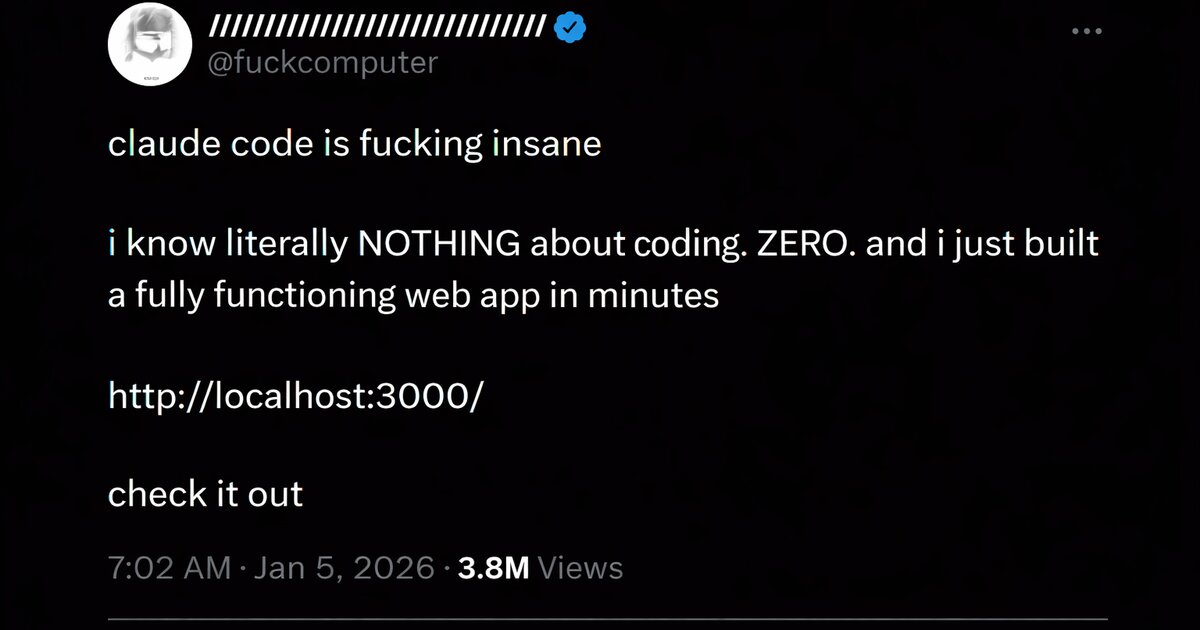
I need to be honest with you about something.
This morning, I knew literally nothing about coding. Zero. I couldn’t tell you the difference between JavaScript and Java. HTML sounded like a disease.
Tonight, I have a fully functioning web app live on the internet. People can use it. It actually works.
What happened in between was Claude Code.
I’m going to walk you through exactly what I did, because if I can do this, you absolutely can too.
What I Was Trying to Build
I wanted a simple tool for my own use. A habit tracker where I could log whether I did certain things each day and see my streaks over time.
Nothing fancy. No AI features. No complex database. Just a clean interface where I could check boxes and track progress.
I figured this would cost me $500-1000 to hire a developer. Or weeks of learning to code myself.
Instead, it cost me a few hours and a Claude Pro subscription.
How Claude Code Actually Works
For anyone who hasn’t used it: Claude Code is essentially an AI that can write, run, and debug code for you. You tell it what you want in plain English. It builds it.
The magic is in the conversation. You’re not writing code. You’re describing what you want and letting Claude figure out how to make it happen.
It’s called “vibe coding” because you’re vibing with the AI about your vision, not writing technical specifications.
My Actual Process (Step by Step)
Step 1: I described what I wanted
My first message to Claude was something like:
“I want to build a simple habit tracker web app. The user should be able to add habits they want to track, check them off each day, and see their current streak for each habit. Keep it simple and clean.”
That’s it. No technical details. Just what I wanted it to do.
Step 2: Claude asked clarifying questions
Claude came back with questions:
- Should users have accounts or is it just for one person?
- Do you want data saved between sessions?
- Any specific design preferences?
I answered: “Just for me, so no accounts needed. Yes save the data. Dark mode, minimal design.”
Step 3: Claude started building
Within minutes, Claude had written the code. I could see it creating files, writing JavaScript, setting up HTML, adding CSS.
I understood maybe 5% of what it was doing. Didn’t matter.
Step 4: I tested and gave feedback
Claude let me preview the app. Some things weren’t quite right:
- “The checkboxes are too small, make them bigger”
- “Can you add a way to delete habits I don’t want anymore?”
- “The streak counter resets when it shouldn’t”
Each time, Claude fixed it. The whole loop took seconds.
Step 5: Claude helped me deploy it
Once I was happy with it, I asked Claude how to put it on the internet. It walked me through deploying to Vercel (which is free for small projects).
Click, click, done. Live web app.
What Blew My Mind
Here’s what I didn’t expect:
It debugs itself. When something broke, Claude didn’t just tell me there was an error. It found the problem, explained what went wrong (in terms I could understand), and fixed it.
It explains as it goes. I actually learned things. Not enough to code myself, but enough to understand what’s happening and make smarter requests.
It remembers context. I didn’t have to re-explain my project every time. Claude remembered what we were building and built on previous work.
The speed is insane. Changes that would take a developer hours happened in seconds. I’d ask for something, and it was just… there.
What This Means for Non-Coders
I’m not going to tell you Claude Code replaces developers. For complex apps, you still need experts.
But for simple tools? For MVPs? For personal projects?
The barrier to entry just disappeared.
Ideas I’ve had sitting in my notes for years - “wouldn’t it be cool if there was an app that…” - I can actually build them now. In hours, not months.
The people who are going to win in 2026 aren’t necessarily the best coders. They’re the people with the best ideas who can communicate them clearly to AI.
Tips for Your First Claude Code Project
Based on my experience:
Start small. Don’t try to build the next Facebook. Pick something simple with clear functionality. Get a win under your belt.
Be specific about what you want. “Make it look good” is less useful than “dark background, rounded corners, blue accent color.”
Iterate fast. Don’t try to get it perfect in one prompt. Build something basic, then refine. Claude is great at small adjustments.
Ask questions. If something doesn’t work or you don’t understand, ask Claude to explain. It’s surprisingly good at teaching.
Save your work. Claude can help you set up version control (Git) so you don’t lose progress. Ask it to help you with this early.
What I’m Building Next
Now that I know this works, I have a list:
- A simple CRM for my freelance business
- A tool that tracks prices on things I want to buy
- A daily journaling app with prompts
- Maybe even something I could sell…
The limiting factor isn’t coding ability anymore. It’s ideas and the time to implement them.
Want to Learn Vibe Coding?
Get the complete guide to building apps with Claude Code, even if you've never written a line of code.
Get the Course →The Honest Truth
Is this app I built production-ready for millions of users? No. There are probably security issues and scalability problems a real developer would catch.
But it works for me. It does what I need it to do. And I built it myself in an afternoon.
For a long time, I had this mental block: “I’m not technical, I can’t build things.”
That block is gone now.
If you’re sitting on ideas because you can’t code, that excuse doesn’t exist anymore. The tools are here. They work. The only question is whether you’re going to use them.
Open Claude Code. Describe something simple you want to build. Watch what happens.
I promise you’ll be surprised.